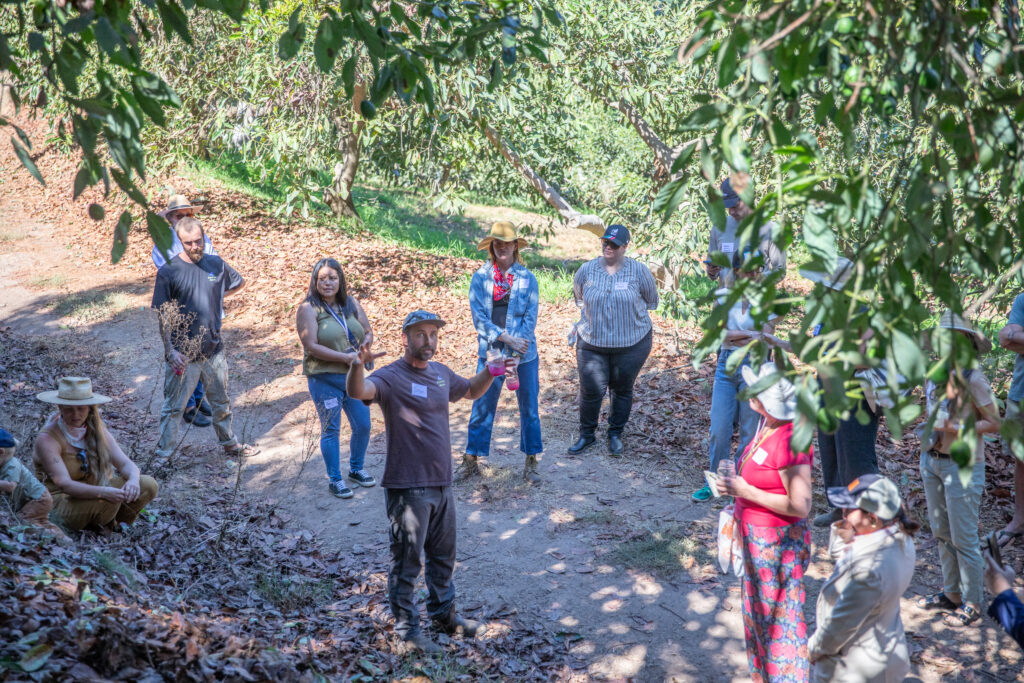
On October 8, CCOF brought together farmers, policymakers, local agricultural organizations, representatives from the California Department of Food and Agriculture (CDFA) and UC Cooperative Extension, and supporters of the CCOF Foundation for an Organic Field Day at Rincon Farms in Carpinteria. We were honored to welcome California Senate President pro Tempore Monique Limón and representatives from Assemblymember Steve Bennett’s office to hear directly from Ventura County farmers about the challenges and opportunities facing California agriculture.
It was a beautiful day to be on the farm. Under sunny skies and a gentle breeze, we walked through thriving avocado orchards filled with birdsong and buzzing bees. Second-generation farmer Sean Bettles has worked to build a healthy, diverse farm ecosystem, and it was evident everywhere we looked. Experiencing the farm firsthand gave us an opportunity to see, hear, smell, and feel the vibrancy of the ecosystem while gaining a deeper understanding of the challenges Sean and other farmers navigate every day.
Sean showed us avocados sunburned by a recent heat wave, and we discussed the potential impacts of heavy precipitation during an El Niño year. Farmers shared the realities of unpredictable weather, rising production costs, and market fluctuations—including what happens when crop prices fall by half, dropping below the cost of production.
These conversations underscored the importance of farm safety net programs like the California Underserved and Small Producer Program (CUSP), which helps small and underserved farmers navigate financial challenges and recover from unexpected losses. Although CUSP did not receive funding from the California Legislature in 2026, CCOF hopes to secure renewed funding in 2027.
Sean also shared his passion for organic farming and the curiosity that drives his approach. From studying the farm ecosystem to developing strategies for managing emerging pests, he demonstrated the observation, adaptability, and problem-solving that organic production requires.
The field day also gave us an opportunity to celebrate California’s recent $15 million investment in the Organic Transition Partnership Program, which supported Sean’s transition to organic production.
Throughout the day, we returned to a central message: It takes an entire community to support a food system that provides food security for all of us. Farmers cannot do it alone. Researchers, agricultural organizations, policymakers, funders, and consumers all play a role in helping farms remain viable and resilient.
We closed the day with a farm-to-table lunch featuring ingredients from Rincon Farms and neighboring farms—a reminder of what these partnerships ultimately support.
Thank you to Sean, his family, and the Rincon Farms team for welcoming us, and to Senator Limón, Assemblymember Bennett’s office, and all the farmers and partners who joined us for a day of learning and connection.
___________
Interested in hosting a CCOF farm or facility tour?
CCOF is looking for members interested in welcoming policymakers, agricultural partners, and other members of the organic community to their farms and facilities. These visits are an opportunity to share your experiences, showcase your operation, and promote organic education.
If you’re a CCOF member interested in hosting a tour, please contact Laetitia Benador at LBenador@ccof.org.